Ethical Elephant Sanctuary in Krabi: No Riding, Here's What You Do
A friend asked me last year if the elephant place near Ao Nang was "one of the good ones." Here's the honest answer, plus what actually happens during the three hours you spend with the elephants.
Ethical Elephant Sanctuary in Krabi: No Riding, Here's What You Do
Published · 8 min read
The short answer
An ethical elephant sanctuary in Krabi does not offer riding, since riding damages an elephant's spine over time.
The half-day visit near Ao Nang runs about three hours and includes feeding, walking with the elephants, and a mud or water session.
Prices start at ฿2490 and include hotel transfer, an English speaking guide, fruit, soft drinks, and accident insurance.
Bring a swimsuit, a towel, and clothes you do not mind ruining, because the mud bath is not optional if you want the full experience.
Children can usually join, but anyone with heart conditions or who is pregnant should sit this one out, and the same rule applies across most of our Krabi tours.
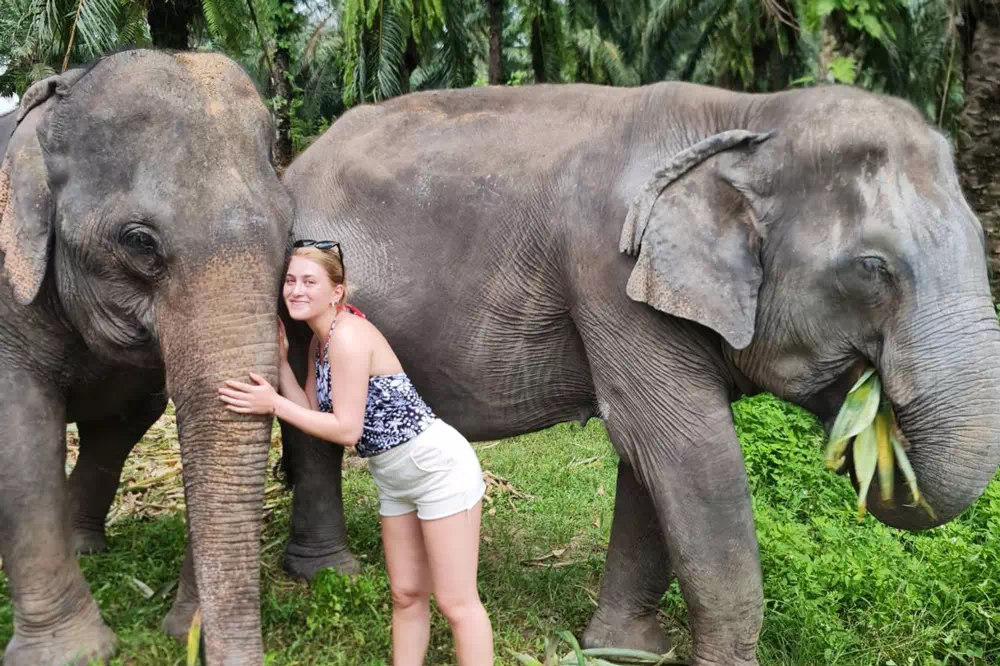
A few years ago I watched a woman cry, quietly, while she stood next to an elephant that was eating pineapple out of her hand. Not a sad cry. The kind you get when something is bigger and older and gentler than you expected it to be. That is the moment most people come to Krabi hoping for, and it is also the moment that gets ruined if you book the wrong kind of elephant experience.
So let's talk about what an ethical elephant sanctuary in Krabi actually looks like, what you do for three hours, and why the no-riding rule is not just marketing language.
What does "ethical elephant sanctuary" actually mean in Krabi?
In Krabi, it means a place where elephants are not ridden, not forced to perform tricks, and not chained for long stretches of the day. The no-riding policy is the single fact that separates a sanctuary from an old-style elephant camp, and it is worth understanding why before you book anything.
Elephants were never built to carry a rigid wooden or metal seat (a howdah) on their backs for hours. Their spines curve upward and are not designed to bear concentrated weight from above, unlike a horse's. Years of riding tourists, combined with the hours of chain time and the harsh training many riding elephants went through as calves, is why the tourism industry across Thailand has been slowly moving away from riding camps toward feeding and bathing sanctuaries instead.
That does not mean every place calling itself a "sanctuary" is automatically trustworthy. Some have simply dropped the riding seats but kept other questionable practices, like chaining elephants tightly between visitor groups or running too many back-to-back visits in a single day for the elephants to get real rest. A separate article on our blog digs into how to spot a genuinely ethical elephant sanctuary in Thailand if you want the longer version of that checklist. For this article, I will stick to what you can expect at the half-day visit near Ao Nang that we book for guests, described in full on the Krabi Ao Nang Elephant Sanctuary Half-Day Tour page.
What do you actually do during the visit?
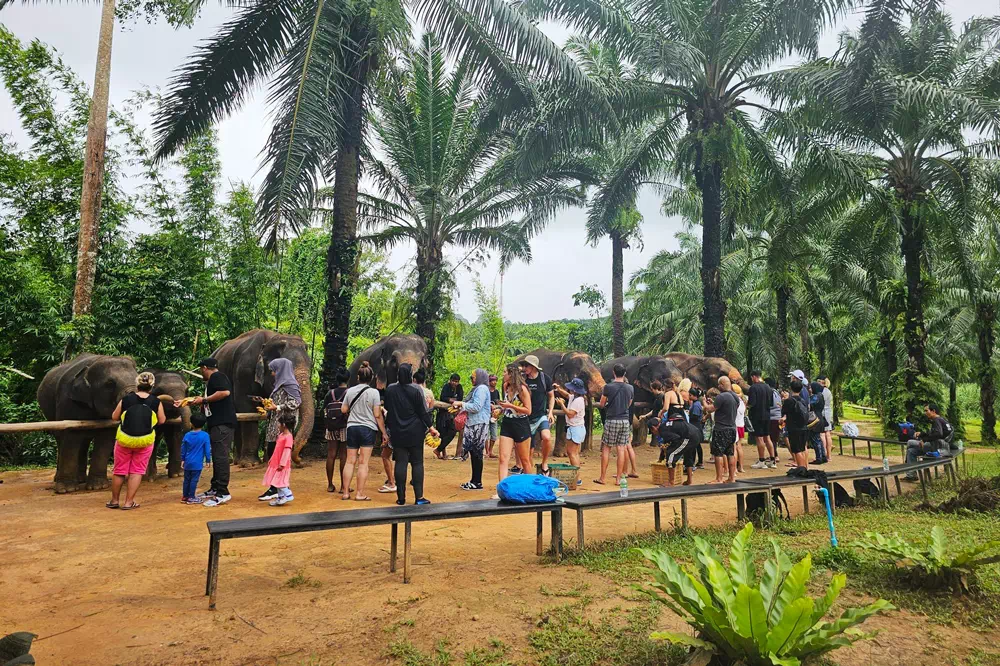
You spend the morning or afternoon feeding, walking beside, and bathing with elephants, not riding them. The visit is built around three main blocks: an introduction to the elephants and their individual stories, a feeding and walking session, and a mud or water bath to finish.
It starts with hotel pickup by minivan, roughly half an hour from most Ao Nang and Krabi Town hotels. On arrival, a guide gives a short orientation: how to approach an elephant, how to hold your hand flat when offering food, and a bit of background on the elephants themselves. Most of them have a story, often a working life in logging or trekking camps before retirement here, and hearing the specifics (an elephant's age, where it came from, how long it has been at the sanctuary) tends to land harder than any general talk about conservation.
Preparing food: you help roll "protein balls" or cut up fruit before feeding time.
Feeding: standing close, offering bananas, watermelon, or sugar cane by hand.
Walking: a slow walk alongside the elephants through the grounds, not on top of them.
Mud bath: smearing mud on the elephants' skin, which they genuinely seem to enjoy.
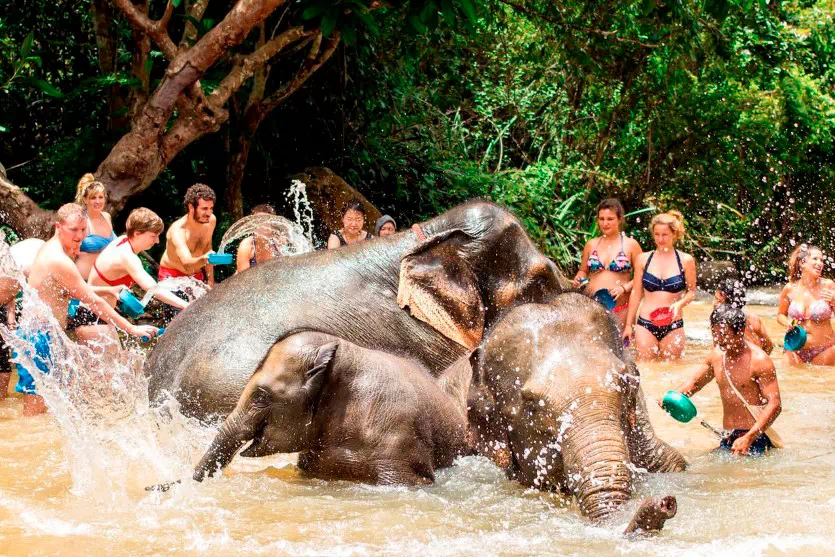
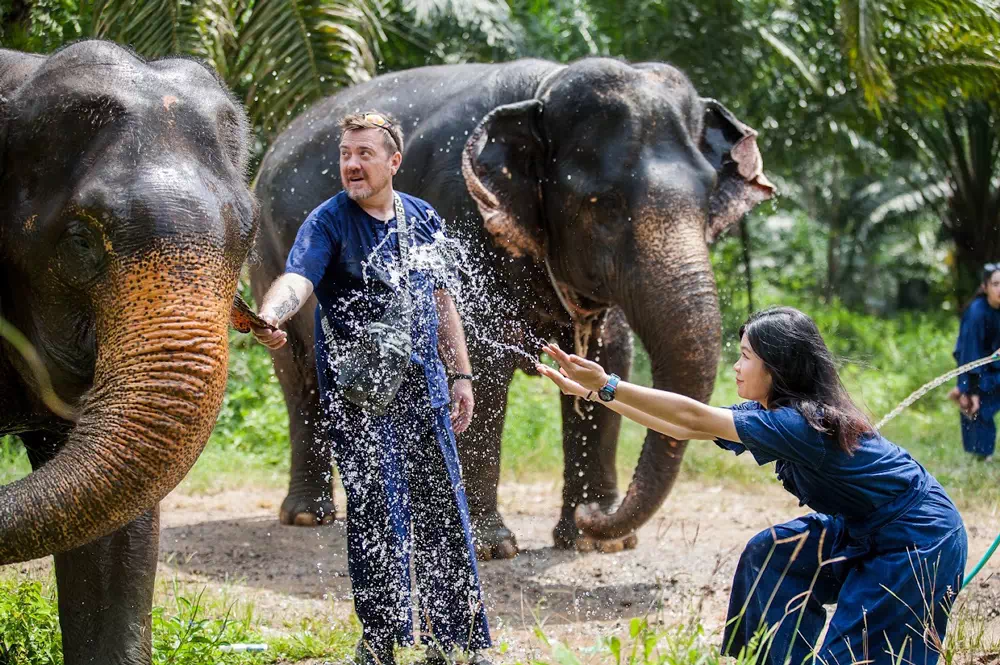
Water time: rinsing them off in a shallow pond or river with buckets.
Feeding time is slower than you expect, there is no rush to move on to the next elephant.
None of this is staged as a show. There is no lineup of tricks, no painting with a trunk, no photo-op posing that the elephants have been trained to hold. The pace is closer to spending time with a very large, very calm dog that happens to be a few hundred times your size.
Bananas disappear fast, bring a sense of humour if an elephant gets impatient waiting for the next one.
Is the mud and water bath messy, and is it worth it?
Yes, it is properly messy, and yes, it is worth it. This is usually the part guests remember most, more than the feeding.
The elephants wade into a shallow pond or muddy river area and you join them with buckets, splashing water over their backs and sides while they (very obviously) enjoy it. Expect to get wet up to your waist at least, and expect your clothes and possibly your hair to end up with a thin layer of mud. Nobody comes out of this part looking photogenic in the traditional sense, but the photos somehow turn out to be everyone's favourites anyway.
Bring shoes you do not mind getting muddy, flip-flops tend to get lost in the river bed.The mud and water session is also where you see how the elephants actually behave off duty, rolling, spraying themselves, leaning into the bath instead of edging away from it, which tells you more about their comfort level than any sign on the wall. If an elephant looks anxious, pulls back from guests, or is kept on a short chain throughout this part, that is a red flag worth remembering for any future sanctuary visit, here or elsewhere in Thailand.
What should you wear, and what should you bring?
Wear a swimsuit under clothes you do not mind staining, and bring a separate dry set for the ride home. The short version: dress like you are going to get muddy and wet, because you are.
Item
Why you need it
Swimsuit
Worn under your clothes for the mud and water bath
Change of clothes
For the transfer back to your hotel afterward
Towel
Sanctuaries are outdoors, you dry off in the open air
Mosquito repellent
The grounds back onto jungle and palm plantation
Passport
Needed for the accident insurance included in the price
Sunscreen
Most of the visit happens outdoors, often in direct sun
Skip anything you are precious about: good shoes, a nice watch, a phone you cannot afford to drop in mud. A dry bag or a cheap waterproof phone pouch is a smart five-minute purchase before you go if you want photos of the water bath itself rather than just the feeding part.
Can kids join, and who should skip this tour?
Children can usually take part, and the slower pace of feeding and walking (rather than anything physically demanding) tends to suit families well. That said, there are clear exceptions worth knowing before you book.
Anyone with a heart condition or other serious medical issue, and pregnant women, are not permitted to join, a rule that applies for safety reasons around the animals and the uneven, sometimes muddy terrain. This is consistent with most of the more physical tours we book around Krabi, so if that applies to you, it is worth checking the rules on any tour page before booking rather than assuming it will be fine on the day.
For younger kids, the appeal is usually straightforward: big friendly animals, mud, water, and the novelty of hand-feeding something enormous. For older kids and teenagers, the stories behind individual elephants (the ones that worked logging camps, the ones rescued from riding tourism elsewhere in Thailand) tend to land better and can turn into a genuinely good conversation about animal welfare, not just a nice morning out.
A guide usually explains each elephant's background before you get close, worth listening to rather than rushing ahead for photos.
How does this compare to other elephant experiences in Thailand?
It compares well against the old riding camps still found in some parts of the country, and reasonably well against other bathing sanctuaries, with the caveat that quality varies site to site. I have visited a few elephant camps over the years, including some from the before-times when riding with a seat was still standard practice almost everywhere, and the difference in how the elephants move and behave is noticeable even to someone without any training in animal behaviour.
An elephant that has spent years giving rides and performing tends to move stiffly, flinches more, and shows less curiosity toward visitors. An elephant at a genuine no-riding sanctuary, especially one that has been retired from that work for a few years, tends to be more relaxed: ears forward, trunk exploring, occasionally even a bit cheeky about stealing extra bananas. None of this is scientific observation on my part, just years of noticing the contrast.
A splash fight tends to break out near the end of the water session, worth keeping your camera on a strap.
If you only have time for one animal-focused activity in the Krabi area, this is the one I would recommend over anything involving performance, costumes, or riding, regardless of where it is offered. If you want a broader sense of what else is worth doing further down the Andaman coast while you are here, our tour pages for the 4 Islands speedboat tour and the Hong Islands longtail tour cover the boat-based side of a Krabi trip, which this half-day land tour pairs well with on a different day.
Booking details and how it fits into your trip
The Krabi Ao Nang Elephant Sanctuary Half-Day Tour runs about three hours and starts at ฿2490 per person, with hotel transfer, an English speaking guide, fresh fruit, soft drinks, and accident insurance included. Because it is a half-day visit, it slots neatly either side of a full-day boat tour on the same trip, morning sanctuary and afternoon pool time, or afternoon sanctuary after a slow morning on the beach.
Pickup is by minivan from your hotel, with the exact meeting time confirmed after booking, and the same van brings you back at the end. The sanctuary itself sits inland from Ao Nang, reached by a short drive through palm plantation, which is part of the charm: you go from beach resort surroundings to working countryside in about thirty minutes.
Here is who else should consider pairing this with something else nearby. Travellers who want a full day of jungle and nature rather than beach can combine it conceptually with the Emerald Pool, Hot Springs and Tiger Cave tour on a different day, since both are inland and nature-focused rather than boat-based. Families staying a week often do the sanctuary one day and an island tour another, which breaks up the trip and avoids too many early starts in a row.
A short list of the things guests ask us most often before confirming:
Duration is around three hours, not a full day, so it is easy to combine with another half-day activity.
No riding is offered at any point, and no site we book through claims otherwise.
Bring a passport, since accident insurance coverage requires it on the day.
Photos happen naturally throughout, nobody is pushed into posed shots.
The sanctuary changes its program slightly depending on elephant mood and weather, so treat the itinerary as a guide rather than a fixed schedule.
If an elephant encounter is the one thing on your Krabi list you do not want to get wrong, book the version with no riding, a real explanation of each elephant's background, and a mud bath instead of a show. That combination is what makes the three hours worth the price, and it is the difference between supporting a retirement home for elephants and supporting the kind of camp that put them to work in the first place.
Frequently asked questions
Is riding elephants available anywhere in Krabi through ethical operators?
No, genuine ethical sanctuaries in Krabi do not offer riding at all, since it is the practice most directly linked to spinal damage and harsh training methods. If a Krabi operator advertises both "ethical" and "riding" in the same listing, treat that as a contradiction rather than a bonus feature.
How long does the elephant sanctuary visit last?
The half-day tour runs about three hours, not counting hotel transfer time of roughly thirty minutes each way. It is designed to be paired with another activity on the same day if you want a fuller schedule.
Do I need to know how to swim for the mud and water bath?
No, the water area used for bathing elephants is shallow, closer to wading depth than swimming depth. You do not need swimming ability, just a willingness to get wet and a bit muddy.
Can solo travellers join, or is it mainly for families?
Solo travellers join regularly, and the small group format (built around a shared minivan transfer) makes it an easy way to meet other travellers during the trip. It is not structured specifically for families, though the pace suits them well too.
What happens to the elephants when they are not with visitors?
At a genuine sanctuary, elephants get rest periods between visitor groups, access to shade, and are not kept in performance routines outside visiting hours. This is one of the things worth asking about directly if you are comparing several sanctuaries before booking.
Is it safe to be this close to elephants without a trained mahout controlling them directly?
Guides and handlers are present throughout and give clear instructions on approach and feeding technique before you get close to any elephant. Elephants at the sanctuary are accustomed to visitors, but you still follow a guide's directions rather than approaching on your own.
Should I tip the handlers or guides?
Tipping is not required but is appreciated and fairly common practice in Thailand for guided tours generally. A small tip at the end of the visit is a reasonable way to acknowledge good care and explanation if you felt it was worth it.
Does the sanctuary visit include lunch?
The half-day tour includes fresh fruit, soft drinks, coffee and tea rather than a full lunch, since it runs roughly three hours rather than a full day. If you are combining it with another activity, plan your own lunch stop around Ao Nang or Krabi Town separately.
Ready to book?
Hotel pickup, insurance and a licensed local operator. Ask us anything on WhatsApp before you book.